
 1 to 4 players
Also solo
1 to 4 players
Also solo
Card Luck & Calculation
Play Card Shark online
Also known as Higher or Lower, Hi-Lo
Higher or lower? Every card carries its own odds — do you cash in, or push your luck until the wrong one turns up?
Free · no sign-up · no download
How it plays
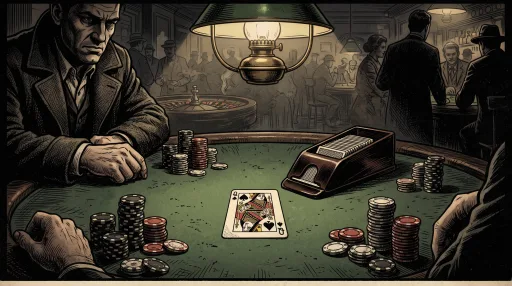
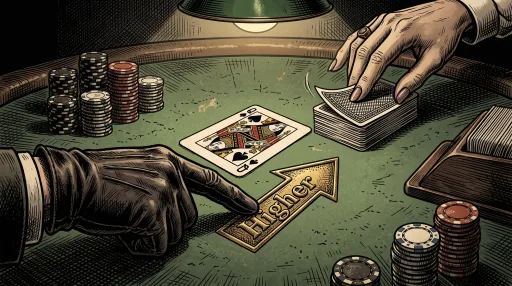
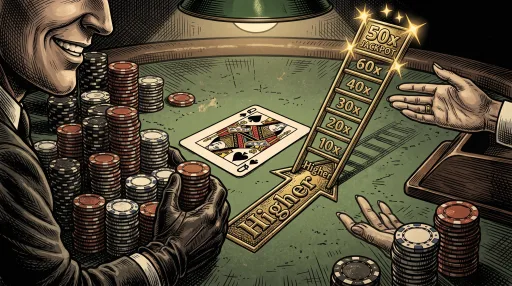
Kartenhai is the card game Higher or Lower for one to four, played with chips that carry no cash value: on your turn, you stake a bet, see a card, and call the next one — higher or equal, lower or equal; a matching value counts as a hit. Each direction carries its own odds, worked out from what's left in the deck, and every hit multiplies your stake — cash in or push your luck, because a wrong call takes it all. Once per round, before an especially risky call, you may insure your stake: the table keeps half of it, and if the call misses, you get the other half back. After five rounds, whoever has the most chips in front of them wins; alone, you play against the table's odds.
The story
Goal and rules
Goal Fattest cushion
Have the most net worth in front of you after five rounds!
Alone, you play five rounds against the odds, and the final tally shows how many chips you took off the table. Net worth is your chips minus credit. If your time runs out, the table bets the minimum, cashes out after a hit, and otherwise guesses the likelier direction: whichever has more hit cards left in the shoe. It never buys insurance.
- Betting On your turn, bet at least ten chips — or everything, if you have less — and get an open card.
- Odds Guess whether the next card is higher-or-equal or lower-or-equal, from Ace (lowest) to King (highest). A matching card value always counts as a hit! The chance on the button says how many of the cards in the shoe hit. The rarer a direction, the higher its odds; the safe direction pays at least ×1.01.
- Cashing out Every hit multiplies the stake by its odds. After that you can cash out: stake times multiplier goes to your chips, and it's the next player's turn.
- Bust A wrong guess costs the stake. Whoever's broke gets 25 chips of credit, which counts against you at the end. Once per round, before a risky guess, you may buy insurance: it costs half the stake, rounded down, and if the next guess misses, you get the other half back instead of nothing. The multiplier is still gone. If the guess hits, the premium is gone anyway and your stake stays halved. After that one guess the insurance is used up.
Do the math: Everyone plays from the same 52-card shoe, without replacement, from Ace (lowest) to King (highest). Every card drawn shifts the odds, since it counts against what's still in the deck. If a direction has no card left, it can't be guessed.
Controls
Tap or click: first an amount under the table, then "Lower" on the left or "Higher" on the right; after a hit also "Cash out", and before a risky guess "Insurance", which saves half the stake. An equal value hits in both directions, so the two chances can add up to more than 100 percent. With a keyboard: Tab and Enter.
In the arena, the goal and the rules are always behind the question mark, even mid-round — and between rounds, so is the story.
Quick Answers
Does Card Shark cost anything?
No. Card Shark is free and ad-free, and there is nothing to buy. You play for points and chips with no cash value, never for money.
How do I play Card Shark with friends?
Press “Open Table” and send the link or the six-character room code to the others. 1 to 4 players take part, everyone else watches. Solo works too: “Play solo” drops you straight into a round, no waiting room.
Do I need to download anything or sign up?
No. Card Shark runs right in your browser, on your phone just as on your computer, with no app, no account and no email address.